

Most agencies have a version of this story: a new hire comes in, goes through OASIS training, gets pretty good within a few months, and then just kind of stops improving. Not bad, not great. Stuck. If that sounds familiar, it is not a training problem you can fix with more training. It is a structural thing worth understanding.
Why the plateau happens
Initial OASIS training does a good job of teaching the basics: how to navigate the assessment, what each item is generally asking, the mechanics of getting through a chart. What it cannot really teach is judgment, and judgment is what separates a clinician who scores accurately from one who scores confidently but inconsistently.
Judgment comes from seeing enough variation. A clinician who has scored GG items for a hundred different presentations of the same general condition starts to develop a real feel for where a specific patient falls. A clinician six months in has usually not seen that much variation yet, and initial training cannot manufacture that experience faster than it actually happens.
On top of that, most agencies do not have a fast, specific feedback loop. A new hire might get general feedback on their charts once a month, or only when something gets flagged in an audit. That is not enough repetition, fast enough, to keep improving past the basics. Skills that get occasional, delayed feedback plateau. Skills that get frequent, specific feedback keep improving.
What this means for new hires specifically
If a new hire is six months in and still making the same kinds of GG0130 or M-item scoring mistakes they made in month two, that is not necessarily a sign they are struggling. It is often just what happens without a structured way to keep building judgment past the initial training period.
This matters for how agencies set expectations. Expecting a new hire to be fully independent and consistently accurate by month three, based only on initial training, sets everyone up for frustration. It is more realistic to expect steady basic competence early, with real judgment building over the following year, especially if there is a consistent feedback loop in place.
What actually helps past the plateau
Fast, specific feedback beats occasional, general feedback every time. A new hire who hears within a day or two that a specific GG0130 score did not match the documentation, and why, builds judgment much faster than one who finds out three weeks later during a chart audit that something was off.
Exposure to a wide range of real cases matters more than repeating the same training modules. Plateaued clinicians usually need to see more variation, not to be re-taught the basics they already have down.
And a second set of eyes on every chart, not just a periodic sample, gives new hires the volume of feedback they actually need to keep improving. This is one of the places where an OASIS QA review layer helps agencies directly: it is not just catching errors before they become payment problems, it is quietly building the judgment of the clinicians whose charts are getting reviewed, because they are getting specific feedback on real charts far more often than a monthly audit could ever provide.
How Olli helps pinpoint your focus
This is the gap our clinician-specific OASIS accuracy scorecard is built to close. Instead of one overall accuracy number for your whole team, every clinician gets their own scorecard broken down by specific OASIS item type, so you can see exactly where a clinician's judgment is solid and exactly where it is still developing.
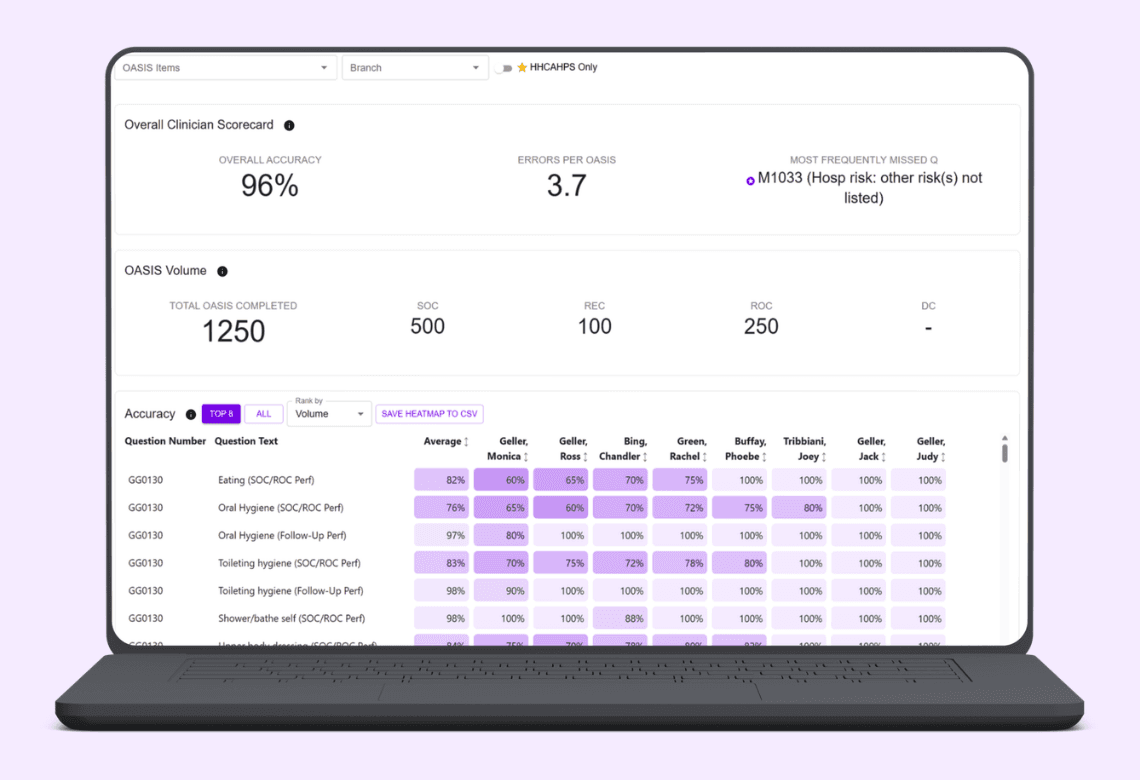
Olli's clinician OASIS Accuracy Scorecard
That level of detail turns "this new hire needs more training" into something a DON or QA lead can actually act on. Instead of guessing which module to repeat, you can look at a scorecard and see, for example, that a clinician's risk assessment scoring has been consistently strong for months while their GG0130 scoring on more complex functional presentations is still catching up. That is a specific, addressable training opportunity, not a general sense that someone needs more practice.
Because the scorecard updates as new charts come through, it also shows whether a clinician's target areas are actually improving over time, not just where they started out.
Adjust expectations, not just training
If your new hires seem stuck, the fix probably is not another round of the same training. It is building in faster, more specific feedback on real charts, and giving people realistic timelines for when judgment actually develops.
Want ongoing support built into your QA process?
We can talk through what an ongoing QA layer looks like for your team, one that gives your newer clinicians the kind of fast, specific feedback that actually moves them past the plateau. Book a call about ongoing QA support today.
OASIS training, workforce development, home health QA