
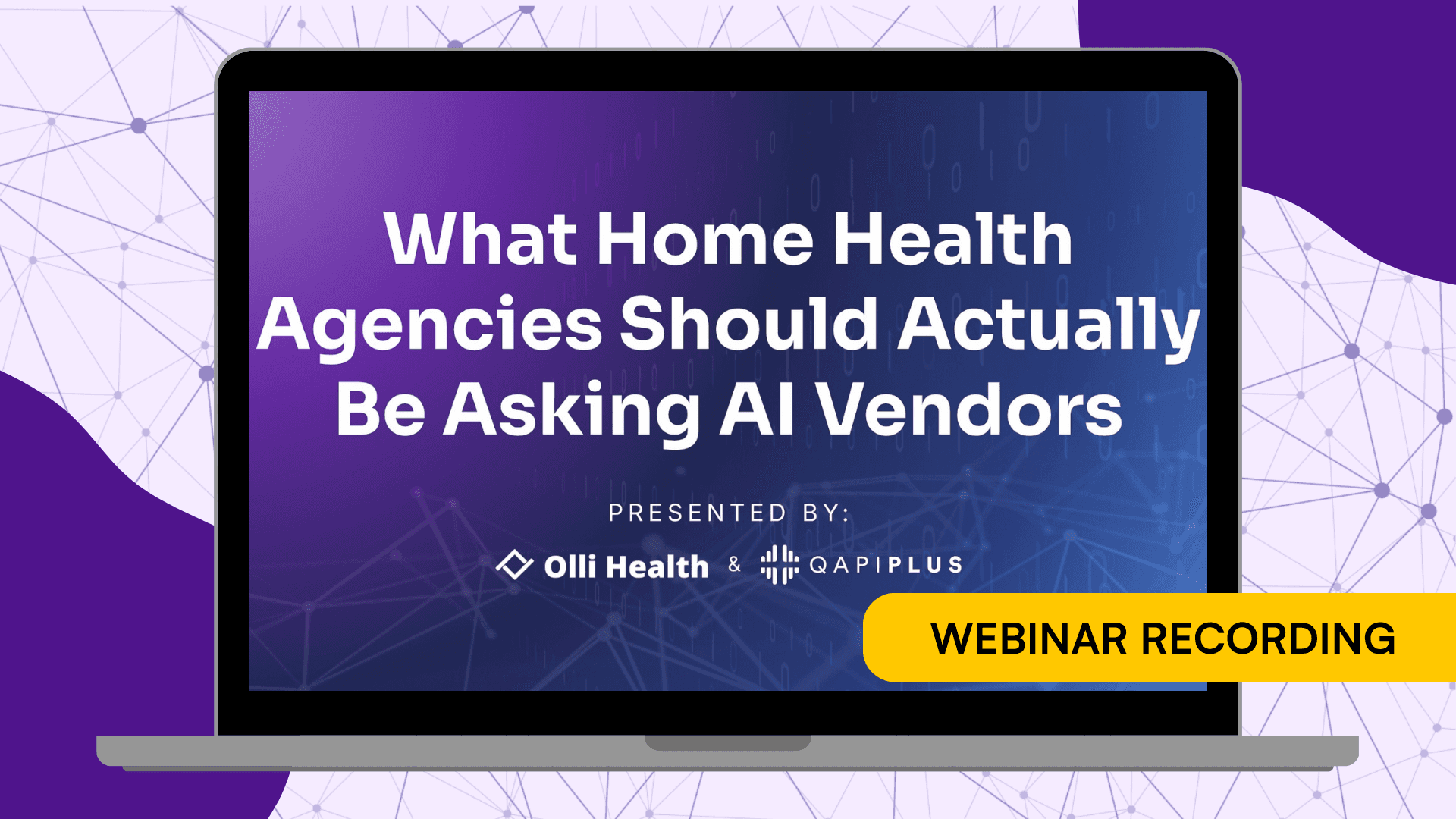
Watch the full recording here.
This session walks through a practical framework for evaluating AI vendors in home health and hospice, covering:
Use case and risk — matching your scrutiny to what the AI actually touches
Data privacy and ownership — who owns your data and how it's used
Compliance and security — BAAs, PHI handling, and HIPAA obligations
Access control — how permissions and user roles are managed
Clinical accuracy and governance — what "human in the loop" actually means versus how vendors use the phrase
Workflow integration — whether a tool fits how your team actually works
Infrastructure security — how data moves and who can access it
ROI and organizational impact — defining measurable outcomes in the first 30, 60, and 90 days
It closes with the warning signs that should slow down any AI vendor conversation, and the questions worth asking before signing with anyone.
Webinar Transcript
Speakers: Chelsey Heil (QAPIplus, Director of Marketing) and Jay Banks (Olli Health, Head of Sales)
CHELSEY HEIL (0:05)
Hello everyone, and welcome. Happy to have you here today to talk about AI. Just a quick housekeeping note before we get started, and then I'll hand it over to Jay. We'll be recording this session and able to send it out to you afterwards, so make sure to take notes if you want, but the presentation will be coming afterwards to you. I'll hand it over to Jay to introduce and get us started.
JAY BANKS (0:36)
Thanks, Chelsey, and welcome everybody. This is going to be more of a practical conversation, not really an AI sales pitch. The objective today will be to help agencies ask better questions of any AI vendor, whether that's Olli or QAPIplus.
AI is really already in the marketplace. The technology is already in the post-acute care workflows. So the issue is no longer about whether the AI exists or whether it belongs. It's whether it's being chosen properly and used responsibly, and as prepared as you can possibly be. Chelsey and I are going to give you a framework you can take straight into your next vendor evaluation and conversation and hopefully implement this in the most effective way possible.
Chelsey, do you want to give a brief intro of yourself and your background? I'll do the same, and then we'll go through the agenda.
CHELSEY HEIL (1:47)
Absolutely. I'm Chelsey Heil, head of marketing here at QAPIplus. I've been in the post-acute space for about five years and really just love the mission and what we're trying to do. So happy to be here. Thank you, Jay.
JAY BANKS (2:03)
Happy to be with you, Chelsey. Essentially, we're going to preview the five themes of today's agenda. So where AI—
CHELSEY HEIL (2:14)
Hold on, Jay, you didn't introduce yourself.
JAY BANKS (2:16)
Oh, that's true. I'm Jay Banks. I am the head of sales at Olli Health. I've been with Olli for close to a year now. It's hard to believe it's flown by that quickly. I've been in home health and hospice for the better part of 20 years, both on the technology side and the provider side. So great to be with you all.
Today's agenda: we're going to talk about where AI actually earns its place in the clinical workflow, but also in other workflows as well. We're going to talk about what human in the loop means, because we still think there's a really important piece of this, whether that's on the vendor side or the provider side. How risk changes depending on what AI touches — there are some more critical workflows that we're going to talk about today. A practical framework that you can use with any vendor when you look to evaluate them, when you look to have continuing conversations, and most importantly, when you look to deploy that particular technology. And the questions that would slow any conversation down or things that leadership should consider as they're evaluating vendors in the marketplace.
Rather than asking whether a product has AI, we want to help you understand what good AI actually looks like in a home health or hospice workflow. So by the end of today's session, you should hopefully be able to distinguish between useful AI vendors and useful AI from risky AI. We're going to emphasize where the human in the loop should be considered, and we're going to describe some actual workflows instead of talking through a particular marketing or sales pitch — we're going to point out documentation, summary tools, care planning, and coding tools that really are ripe for the technology.
We're going to cover 8 areas with practical warning signs and questions that you can use immediately. So we're going to try to give you some tools that will be helpful in your search or as you're continuing your AI adoption within your own agencies.
The first mindset shift is relatively simple. It's really to stop asking whether you should use AI. I think it's here to stay. It's no longer theoretical. It's supporting clinical documentation, it's supporting quality oversight, it's supporting particular workflow efficiencies, risk detection, operational efficiencies. Home health, as you all know better than anybody, is facing sort of the perfect storm as it relates to staffing pressures, regulatory compliance, more and more documentation required. I know the final rule has some of that both for home health and for hospice, so more and more documentation that we need to comply with. And obviously margin pressure — margins are extremely small in our industry. We want to help compress the cost structure using these tools.
I think the better question, as we talk throughout today, is not should we use AI, it's which partner can prove what they're actually telling us, with stories. A strong partner should really explain how the data is protected, how the output is validated from a quality and compliance perspective, how humans are still in the loop and stay accountable, and how the value is going to be measured in the end, because ultimately there needs to be an ROI story as well.
So that brings us to the line item that matters most: what should AI do and what must people still own? AI obviously is going to help handle volume and not necessarily judgment, although we are seeing some tools that are evolving in that realm. It's an excellent pattern recognition, especially at scale. So it's able to review large amounts of documentation and surface trends and gaps faster than humans can by themselves. But the AI should not be the final authority on what is clinically valid, or what matters enough to act on, or what happens next for the patient. The line between automation and judgment matters more than how impressive the model actually sounds. So if you're talking to a vendor and they imply that the AI independently makes clinical truth or final decisions, I would caution that — put a governor on that, slow the conversation down, and talk about where the human in the loop actually comes into play.
This is where that phrase human in the loop gets important, and also where vendors get very vague sometimes. So what I would do on the provider side is ask the vendor to show exactly where the human comes in the loop. Again, the human in the loop can be either on the vendor side or on the provider side, or both, both in the solution and in the workflow — the ability for someone to review something, where that shows up in the workflow.
Real human in the loop means clinicians, back office staff, team members can review, edit, reject, correct the outputs before approving those or applying those outputs to become actionable. And corrections should really be captured and used to improve quality over time, rather than disappearing one after another. So one of the things that we think is really important is providing actionable data as we use the AI technology to help the organization get better and better. We think over time that AI should not only be retroactive in its ability to spot gaps or errors, but it should be used as a process improvement tool. And I know nobody knows that better than Chelsey and QAPIplus does.
Once the human role is clear in this process, the next question is where AI actually creates value. Huge documentation volume, distributed teams, changing patient conditions, ever-changing compliance and regulatory concerns, and the operational pressure at the same time help create this sort of opportunity for us. Where AI comes into place, and the partners that you choose, is when it improves the visibility, the consistency, and really the earlier intervention — not simply when it produces more information, but does it provide actionable information as you're going. The goal is to surface those risks earlier and more often, identify the trends both from an organizational perspective, from a team perspective, and down to the individual, whether that be a clinician.
Hopefully it also is going to reduce the administrative burden and help leaders act sooner. We know leaders have so much on their plate at this point in time, especially with the margins as they are. We see clinical leaders oftentimes out in the field doing operational work. We see operational leaders helping out with areas that aren't within their functional area. So we want to be able to help them go deep as a vendor versus have to go wide. And the one useful test is: does the tool or the company that we're evaluating make somebody better at their job? Does it lead to a faster decision, or does it simply generate another dashboard that doesn't get used? We see that many times, having been in the industry for so long.
And to evaluate consistency, we need a framework that goes beyond the product that you're looking at, that goes beyond the vendor that you're looking at. So here's an AI vendor evaluation framework, surfaced along 8 areas: use case and risk, data privacy and ownership, compliance and security, access control and authentication, clinical accuracy and governance, workflow integration, infrastructure security, and ROI and organizational impact. The framework intentionally combines clinical, operational, and technical diligence, because we think those three are important.
And the goal is not to necessarily pick the most impressive-looking AI on the surface. It's to select something that is proven, that is explainable, something — a partner that is a responsible partner that can support your healthcare workflows and knows them at a deep level. We see several AI vendors coming in from outside the industry, outside the home health and hospice space. Some of them are promising. Some of them really don't understand the deep knowledge that it takes, at least in the short term, to really apply those to the workflows that you're looking at.
So we'll start with the most fundamental question, which is: what exactly is AI being asked to do, and what risk comes with that use case? Before you get into features and integrations or dashboards, define the actual problem that the partner is solving for you. Risk should be assessed on what the AI touches and what downstream consequences could result.
The first question that you might have for any partner is: what task, decision, or workflow does this AI ideally support? Not all partners or platforms carry the same risk. An administrative summary is fundamentally different from a tool that either reviews clinical documentation or creates clinical documentation, or is flagging patient risk, or is influencing your reimbursement. So — what decision or task or workflow does the AI support, and who's going to rely in the organization on its output? As that solution gets closer to patient care, reimbursement, or compliance, the need for validation, oversight, and accountability goes up.
Examples that we'll talk about include documentation support, referral intake, eligibility support, clinical review. There are tools out there for patient risk flagging, intervention suggestions, care plan suggestions, quality and compliance trend detection, and reimbursement impact to your agency.
So once you know the use case, classify the risk first instead of treating every tool the same, because they're not. Lower risk examples: administrative summaries, operational dashboards, staff education. Moderate risk: after-the-fact documentation review, QA support, trend detection, patient risk identification. High risk examples: eligibility, care planning, billing, clinical decision support — things that are going to affect either your patient outcomes or your reimbursement.
A simple rule is: the closer the AI gets to either care decisions, regulatory requirements, or reimbursement, the more rigorous your evaluation should be of that tool. The mistake is using one generic AI checklist regardless of what the tool actually does. So you want to risk-stratify those things and match the scrutiny to that. A documentation summary tool, for instance, will condense information a clinician has already created and reviewed. A coding or care planning tool can ultimately affect regulatory outcomes, but it can also affect the shape of billing or care itself. Those workflows have very different consequences and they shouldn't be evaluated with the same level of scrutiny. So match your questions to what the tool touches, not the category the vendor puts themselves in. If there's a high patient safety implication, a regulatory implication, or financial impact, the stronger the human review and the stronger the validation, proof point of that validation, and clear accountability need to take place.
After use case and the risk, the next logical question is what happens to the data. Chelsey will take us into privacy and ownership.
CHELSEY HEIL (17:40)
Absolutely. Thank you, Jay.
So we just talked through the use case and risk. Now let's move into data and privacy. Once we understand the risk level of an AI use case, we need to understand what happens to the data. Let's walk through why privacy and ownership are foundational when you're evaluating an AI partner in the healthcare space.
When evaluating that partner, one of the most important questions should be: what happens to our data? In our space, protecting patient and organizational information is not optional. It's really foundational and required. Organizations need to clearly understand who owns the data, where it's stored, how long it's retained, and whether customer information is being used to train AI models. A strong vendor really should be transparent about access controls, security protections, and retention policies, and these answers should be clearly documented in contracts or business agreements.
A simple principle to remember is: your data should never become someone else's training set without your knowledge or permission. If a vendor cannot clearly explain how your data is protected and governed, that should raise concern for you.
Once you have that big-picture understanding of privacy and ownership, you need to next understand what specific questions your agency should ask an AI vendor before moving forward. Here are some of those key questions: Who owns the data? Is customer information used to train those AI models? Can we opt out of model training? How is data stored, transmitted, and retained? What happens to our information if we end the relationship? You should also ask whether AI-generated outputs are reviewed, validated, or supervised before being relied upon for clinical or operational workflows.
And remember the simple rule: if the answers are unclear, slow down before moving forward. In healthcare, we trust, but we verify.
Those questions help move that process along. That covers privacy and trust, but then we need to go through how we can evaluate compliance and security, because good intentions are not enough if the system protecting the data is weak.
In healthcare, compliance and security should never be an afterthought. They should be the starting point. Just because a solution uses AI does not mean it operates outside normal healthcare expectations. If a vendor handles PHI, organizations need to evaluate them with the same rigor that they would any other healthcare tech partner. Using AI does not remove those HIPAA obligations. Organizations remain responsible for protecting patient information and ensuring appropriate oversight.
These questions can help leaders look beyond a product demo and really understand whether the solution is secure, usable, responsible, and ready for real healthcare workflows. When evaluating a vendor, ask practical security questions about BAAs, subprocessors, where the data is hosted, insurance for liability, and cyber liability. If the responses are vague or overly technical without landing on specifics, treat that as a signal to slow down and ask more questions.
Then we move into access control and authentication. A field clinician, QA reviewer, billing manager, administrator, and executive may each need different levels of access into the platform. A strong AI partner should support the principle of least privilege — meaning users only receive access to necessary information to perform their role.
Simply having a vendor say "we are HIPAA compliant" should not be accepted without further documentation. If a vendor can't explain how their permissions work, ask them to show you, not just tell you, so that you can understand who can see what and when.
Up until this point, we've focused on privacy, security, and ensuring the right people have access to the right information. But even a secure AI system is not enough if the output can't be trusted clinically. One of the biggest risks in AI is that it can sound very confident even when it's wrong. In healthcare, this matters because inaccurate outputs can create real consequences — across patient safety, documentation errors, compliance exposure, and operational decisions being based on incomplete or faulty information.
Organizations should never assume an AI tool is clinically reliable simply because it works well in another setting or gives polished answers. You need to ask whether the technology has been validated for the environment it will be used in. For example, a model trained broadly may not understand the unique documentation, regulatory, or workflow realities of home health and hospice. Strong AI governance means there's human oversight, monitoring, feedback loops, and a clear process for validating outputs and correcting errors over time. In post-acute care, we really believe AI should support clinical judgment, not replace it. The goal is simply to strengthen decision-making while keeping accountability and clinical expertise at the center.
When evaluating clinical accuracy and governance, organizations should ask direct questions rather than assume that it's reliable. Start with the basics: was this platform developed with clinical input? Does the vendor actually understand post-acute workflows and the realities of home health and hospice? It's also important to ask how accuracy is measured and monitored over time, what happens if outputs are inaccurate or unsafe, and how errors are tracked, updates communicated, and known limitations disclosed. AI quality should be monitored continuously, not assumed after implementation. In our space specifically, trust in AI needs to be earned through oversight, transparency, and ongoing validation.
Strong governance means AI outputs should never be treated as automatic truth. They need to be reviewable, correctable, explainable, and auditable. Teams need to understand what the AI is recommending, why it generated that output, and whether staff can review or challenge it when needed. Clinicians should be able to edit, reject, or correct outputs, and organizations should have visibility into how decisions are made and tracked over time. If an AI recommendation cannot be explained or audited, it becomes difficult to trust in a clinical or compliance environment.
So really, what we're saying is clinicians should always remain in control of final decisions. AI can support that expertise in decision-making, but it doesn't replace professional judgment or accountability.
JAY BANKS (27:09)
Awesome. Thanks, Chelsey. Even at a high level, AI can fail if it creates operational friction or burden. Clinical accuracy and governance matter, but adoption ultimately depends on whether the partner and the platform fit how people actually work. So the next question you'll want to ask isn't just does the platform work and can they validate it, but does it work inside of our existing workflow?
There are some warning signs. If you start to see extra clicks, duplicate documentation, copy-and-paste work, alert fatigue, and poor adoption. You want to ask your vendor partner to demonstrate the workflow for the actual user — whether that user is a clinician, a QA reviewer, a biller, administrator, or executive — and make sure the tool or platform doesn't require teams to leave their natural workflow or maintain some parallel process that erases the value of what the platform promises.
The goal is obviously to reduce burden, not simply to introduce another application. That means workflow diligence needs to get very practical. Ask: does this fit within the current process? Who's going to benefit from the organizational or agency perspective? Who's ultimately accountable for reviewing the output of this tool? Confirm whether it supports your clinician workflows, and whether alerts, tasks, dashboards, or reports are created — how and where they're put in the process. Ask how alerts are prioritized and whether notification or alert volume can be controlled in some way. And identify an internal owner for adoption — your champion or super user. Technology alone does not drive behavioral change. You need change management, and part of that is identifying those champions early on and making sure they're able to communicate, because nobody has as much sway on AI and technology as trusted peers within the organization.
The strongest implementations will work alongside the platform partner to look at redesigning the workflow around the capability, rather than bolting AI onto an already overloaded process. A strong vendor partner should be able to not only describe this, but show it to you and help you work through it.
What strong operational integration looks like: ask for role-specific demonstrations. Show us how we'd use this during our workflow. Show us the QA workflows — how it reviews documentation gaps. Show us how leadership might identify trends at the organizational level, the team level, or the clinician level. Show us how this works with the EMR we're using. The vendor should use the minimum system and data access necessary for the agreed function, and it should operate in a frictionless way. A clear data flow explanation should show what information moves, where it goes, how it's protected, and who can access it. If your vendor partner can't clearly demonstrate the workflow, slow down and ask good questions.
Even a technically strong workflow still requires change management on the agency side. AI adoption isn't just a software or technology switch — sometimes it does require operational change, but the less the better. Expect concerns about replacement, training burden, and how long it will take to ramp back up to productivity expectations. A strong partner should be able to provide a clear implementation plan, workflow mapping, staff training, user and super-user support, pilots or feedback loops to test things out, and post-launch adoption support. As a leader within your organization, set the internal messaging correctly: the AI tool or platform is there to support clinical judgment, reduce burden, improve quality, and strengthen oversight — not replace the work currently being done.
CHELSEY HEIL (33:43)
Thank you, Jay. I think a lot of the time we skip over what happens after somebody adopts an AI platform, and change management is the biggest piece of that — making sure you have the right processes in place to make your new partner successful. So thank you for covering that.
This is the part of the conversation that tends to get glossed over because it sounds technical, but it doesn't need to. A good vendor should be able to explain infrastructure and technology in plain language and paint a clear picture of what that means. These are the questions that should be asked in those conversations: a good AI vendor should be able to explain in plain language how their platform connects to your systems, whether access is limited to only what's needed, and what happens if the connection goes down. If they can hand you a data flow diagram that shows what moves where and who can see it, that's a really strong sign that they've got their systems in order. If the answers get vague or overly jargon-heavy without landing on specifics, treat that the same way you would any other unclear answer — slow down, ask again.
JAY BANKS (35:26)
Thanks, Chelsey. Let's talk ROI and organizational impact. Obviously, visibility into the data isn't enough — a dashboard only really matters if it leads to action and measurable improvement. So you want to treat your AI vendor, partner, or platform like any other operational investment. Define what success looks like. Create your future story, and map out where you're at today against where you want to be from an ROI perspective. The key question becomes: how will you know if this is actually improving performance?
So how do you measure ROI and organizational impact? Define success before implementation, or you're going to have vendors claiming vague wins that are really difficult to verify. Possible outcomes include fewer documentation errors, stronger compliance, improved productivity, faster QA turnaround time, earlier risk detection, less administrative work, and better quality performance. The metric should really connect directly to the business problem that justified the investment. AI should not merely feel innovative — it should create some sort of measurable operational improvement. And you can't measure improvement if you don't know your starting point.
Start with the baseline — establish your current-state metrics before you go live. Examples include documentation completion time, QA turnaround, late notes, rework, missed visits, survey deficiencies, clinician productivity, manual review hours, quality scores, and staff satisfaction. Choose metrics that are tied to the problem you're solving. Don't measure everything simply because you can, or because you feel like you have so much on your plate — narrow your focus to the problem you're really trying to solve. Without that baseline, you can't credibly show ROI or determine whether the technology is working.
Once the baseline is clear, you can broaden the definition of ROI beyond cost savings: productivity gains, fewer manual audits, better capacity, fewer administrative touches. Is there a quality component — more complete assessments, better QAPI reporting, improved audit or survey readiness? What are the operational or financial impacts — reduced rework, faster billing, faster DSO, better staff utilization, improved throughput, reduced avoidable readmission burden? What about staff experience — less repetitive work, less documentation frustration, clearer QA feedback? I know QA feedback lands differently coming from a trusted vendor partner than it does coming from internally — I've seen that on the provider side, having run an agency myself. And compliance ROI — earlier identification of missing documentation, more consistent review, stronger audit trails.
ROI is financial, operational, clinical, compliance-related, and human. From there, you can work with your vendor partner to hold both sides accountable to a timeline for achieving and measuring those results.
The most important ROI question is really: what measurable outcomes should we expect in the first 30, 60, and 90 days? You want a specific, realistic answer tied to a baseline. If you and your partner together can't define measurable outcomes clearly, that's a reason to slow down and ask more questions. AI success should be demonstrated not just through referrals and client success stories, but also through outside organizations that validate the claims — not just assumed.
CHELSEY HEIL (41:17)
Here we go. Thank you, Jay. We've walked through all eight areas of the framework, from use case and risk all the way through ROI. Before we close, we want to bring it all together. The goal isn't to make you an AI expert overnight — it's really to give you a way to separate a vendor with real accountability from one that's just really good at a sales pitch.
A few final takeaways, and then if you have any questions, put them in the Q&A chat and we'll answer them in a few minutes.
Here are some warning signs when evaluating an AI partner that should make an organization pause and ask more questions. If the vendor cannot clearly explain how data is used, where it is stored, whether it is retained, and who has access to it, that's a big red flag. The same applies if they can't sign a BAA when PHI is involved, provide security documentation, support audit logs, or explain how accuracy and errors are managed. In the post-acute space specifically, AI shouldn't be a black box. Responsible vendors should be able to explain their safeguards, their workflow fit, their human review process, and the measurable outcomes they're helping the organization achieve.
As a final takeaway to summarize what we've covered: AI is no longer a future concept in our space. It's becoming part of how agencies manage quality, compliance, documentation, and operational performance. And the opportunity is real — AI can reduce your administrative burden, surface risks earlier, support better oversight, and help teams make more informed decisions. It really depends on how responsibly it's selected, implemented, and governed. The agencies that benefit most aren't the ones adopting it fastest — they're the ones asking the right questions of their AI vendors, involving the right stakeholders, protecting their data, supporting their staff, and measuring whether the AI is actually working to improve time savings and everything else. The goal isn't simply to use AI — it's to use AI safely, thoughtfully, and effectively to strengthen care, compliance, and operations.
So if anyone has questions, we'd love to answer them.
Q: You touched on it, but when a vendor says their tool is accurate, what should a quality leader push back with? What does real accuracy evidence look like?
JAY BANKS (44:41)
Yeah, it depends on the workflow they're addressing and what their accuracy claim is. I'll give you an example with Olli. We believe the real value is the quality of the documentation and the regulatory compliance associated with it. One of the things we do is go through a rigorous internal process to check whether humans can validate how accurate the data is, and then whether we can work with independent third-party organizations to validate and substantiate our claims. That's one of the things we've done — working with third parties. We also have several customer references, testimonials, and case studies that speak to the quality of the output, and the quality of the work we do, and our responsiveness as a vendor. All of that goes into it. And we'll continue, as a vendor, to make sure our claims are accurate, both from a client or customer perspective and from a trusted, independent third-party perspective within the home health and hospice space. Hopefully that answers the question.
JAY BANKS (46:16)
While we wait for other questions — I'm actually at a customer location right now, and oddly enough we were just talking about AI in their particular workflows. One of the topics that came up was twofold. One of the questions we get asked is: are AI vendors moving from mere point solutions to more workflow-based solutions — solving one particular problem versus solving an end-to-end problem? And the answer is yes. As you work with your AI partner on a particular point problem, one of the things you want to do as a provider is work collaboratively with them on other adjacent projects that may impact your organization. Many times, they can help you solve other problems within the organization.
The other question that came up frequently was how these AI vendors are continuing to work with the EHR. One of the things I find in our industry is that we have a lot of EHR vendors that do a great job, but the technology was built at a time when many of these AI solutions weren't available. So I think things like APIs and integrations are coming along. These EHR partners feel the weight of that as new innovations come about, and I'd say work with your EHR partners to surface some of these trusted AI partners and make sure you're working collaboratively with them. I think a large percentage of each EHR budget just goes to regulatory updates, and I sort of empathize with the EHRs — a lot of these point solutions or workflow solutions are relatively new to the market. I do see some promising signs in terms of EHR vendors either building out point-to-point integrations or open API models to continue working with API-based workflow solutions. So I'd encourage everyone on this call to continue working with your EHR partners collaboratively, surface what's working for you, and give them a little patience in getting to a model where it's more seamlessly integrated into their EHR.
CHELSEY HEIL (48:46)
That's a good point. And I feel like the EHRs out there do such a great job on this piece of the puzzle, but really the AI vendors and other vendors that add support on top of that have become such experts in those niche areas that you need them to be. So that collaboration goes a long way.
We had another question come through: "I've heard the principle that the person who documented the care shouldn't be the one reviewing it. Why does that matter so much, and how should an agency build that separation?"
JAY BANKS (49:33)
It's interesting — there are inherent biases in the individual who documented the care versus somebody reviewing it. That's number one. Number two, some of these functions are highly specialized. You'll have clinicians on staff who aren't necessarily certified coders or QA specialists, and they haven't worked with review from that perspective. So you want to make sure you can cleanly separate those functions, so the experts in their particular domain handle those particular tasks, while still creating a smooth workflow.
So yes, I agree with the principle that the person who documented the care shouldn't be the one reviewing it. I'd go a step further — even among the people who documented the care, there are varying levels of proficiency in both documentation and overall clinical review. When I had the chance to be on the provider side, all of our clinicians were wonderful, but they would evaluate the same patient differently and have different interpretations of what they were seeing in the documentation. So you want independence in that review process, handled by someone who's an expert in that area.
CHELSEY HEIL (51:14)
Absolutely. And I think when we talk about bias on the documentation side, that also comes through on the review side. We want to provide the best care possible, but we're also working with these people every day, so some bias happens naturally out of that. Removing that, and being able to do some of these reviews at scale, makes that data a lot more impactful for your agency.
JAY BANKS (51:51)
That's a great point. I think, as we talked about at the beginning of the presentation, AI shouldn't replace judgment, but it should help with the scale of the organization. There are some reviews of data that should absolutely be done internally, but the AI vendor should be able to help you scale that and make it more predictable and repeatable.
CHELSEY HEIL (52:19)
Exactly. And I like this one: "Human in the loop gets said often. Right now, in practice, what separates a real human check from a checkbox?"
JAY BANKS (52:36)
For us, it's all about the quality of the output. We feel the technology has helped speed that up, but we hang our hat on this: it will pass muster as it relates to regulatory scrutiny, and it will pass muster as it relates to billing scrutiny — and then we prove that out. The reality is, we use AI technology, but the real product we provide is accuracy and quality. We just do it faster and at a lower price point than if you used humans only in the loop. I think the proof that it isn't just a checkbox for us is the quality standard we're held to.
CHELSEY HEIL (53:44)
Absolutely. From our end, human in the loop is really at the base of what we're doing. Our model is trained with clinician expertise and review at the very foundation of the product. As we get information back from our AI chart audits, it's reviewed internally, and it can also be reviewed by any clinician out there, in plain language aligned to regulation. So you can spot-check and confirm — yes, this is exactly what I was looking for, or no, I need to go back to my AI vendor and show them what I'm seeing and why I think something's different. Being able to have those conversations and provide that feedback only makes the product stronger in the end.
One last question: "For an agency that already feels behind on this, where do you tell them to start? What's the first use case where AI earns its place without too much risk?"
JAY BANKS (55:09)
Obviously, we have biases — however, I'd say a good place to start is an area with some mass adoption in the marketplace. Early adopters have started partnering with these AI vendors and have data to show it's moving the needle. Particularly if you're a risk-averse organization, I'd start with vendors that are proven in the market and can walk you through a frictionless process to pilot a solution — one that automates an existing pain point without being overly complicated from a change management perspective. I think that's a good place to start.
CHELSEY HEIL (56:15)
Absolutely. And I'd also say, look at where you're struggling. Where is this going to make the biggest impact for your team? Because that's going to be different for every agency.
I think those are all the questions that came in. I just want to thank everyone, and thank you, Jay, for being here and talking about this with me. I hope everyone got something out of it. Like I said, we'll make sure to send out the presentation. If any more questions come up afterward, reach out to either of us, and we'll be happy to answer them or pass you along to the right person who can.
JAY BANKS (57:00)
Thank you, Chelsey. Thanks, everybody.
CHELSEY HEIL (57:02)
Yeah. Have a wonderful day.